
Understanding TB-500: Molecular Structure
TB-500 is not the full 43-amino-acid thymosin beta-4 (Tβ4) protein. Chemically, it is an N-acetylated seven-amino-acid fragment corresponding to residues 17–23 of Tβ4: Ac-Leu-Lys-Lys-Thr-Glu-Thr-Gln-OH, commonly written Ac-LKKTETQ.
Important: Peptide products available through RL Australia are intended for laboratory and research use only. They are not for human consumption, not for clinical treatment, and not for personal use. Purchasers must be 18 or older and must use products solely for legitimate research purposes.
Core Structure
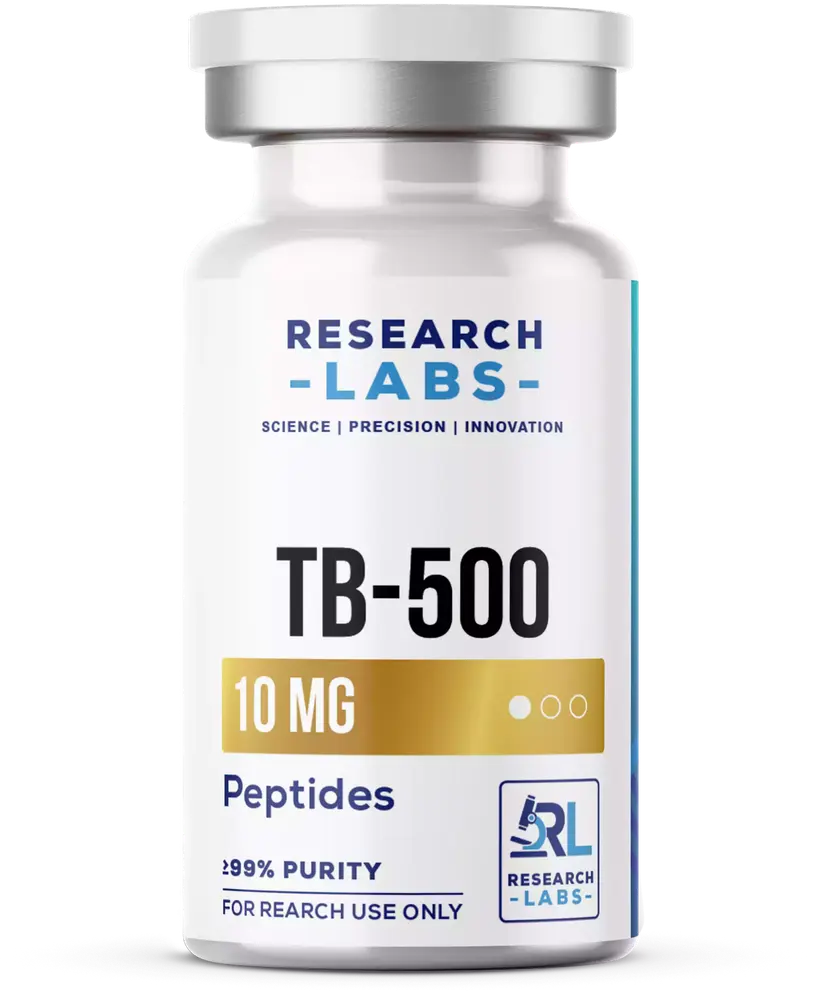
TB-500 10mg research vial format.
| Property | TB-500 |
|---|---|
| Peptide type | Synthetic heptapeptide (seven amino acids). |
| Sequence | Ac-LKKTETQ-OH. |
| Parent protein | Thymosin beta-4, residues 17–23. |
| Molecular formula | C38H68N10O14. |
| Molecular weight | 889.01 g/mol (free base). |
| CAS number | 885340-08-9. |
| Common salt form | TB-500 acetate. |
The seven residues are leucine (Leu), lysine (Lys), lysine (Lys), threonine (Thr), glutamic acid (Glu), threonine (Thr), and glutamine (Gln). The N-terminal leucine carries an added acetyl group, while the C-terminus ends in a free carboxylic acid group rather than an amide.
Relationship to Thymosin Beta-4
Full-length thymosin beta-4 is a 43-amino-acid protein with an approximate molecular weight of 4,963 Da. TB-500 corresponds only to its residues 17–23, so it is a small fragment—not the complete parent molecule.
The LKKTET portion is particularly important because it overlaps the region associated with actin binding in thymosin beta-4. The added acetyl cap is a synthetic modification at the N-terminus and is not simply a direct copy of the unmodified natural fragment.
Structural Behavior
TB-500 is a short, flexible peptide rather than a rigidly folded protein. Like thymosin beta-4, it is considered intrinsically disordered in solution, meaning it does not maintain one fixed three-dimensional shape until it interacts with a binding partner.
The LKKTET motif is thought to engage actin, a structural protein involved in cell movement and the cytoskeleton. In structural models, lysine residues may form electrostatic interactions with actin, while the threonine and glutamate residues help stabilize the binding interface.
Why the Acetyl Group Matters
The N-terminal acetylation changes the peptide’s chemistry by capping the free amine at the beginning of the chain. This modification is commonly described as reducing susceptibility to proteolytic cleavage and improving metabolic stability relative to the unacetylated fragment.
It also means that “TB-500” should not be treated as interchangeable with full-length thymosin beta-4 in experimental interpretation. The two molecules differ in size, sequence completeness, charge distribution, and likely pharmacokinetic behavior.
Solubility and Handling Implications
TB-500’s composition includes polar and charged residues—two lysines, one glutamate, two threonines, and one glutamine—which helps explain its water solubility. It lacks a substantial hydrophobic core, so it does not behave like a lipid-soluble small molecule.
For research handling, this structural profile makes proper storage, reconstitution, and batch-specific analytical verification important. Peptide identity and purity should be confirmed with methods such as HPLC and mass spectrometry, since synthesis-related impurities and degradation products can affect experimental results.
Research Context
TB-500 is studied as a fragment related to thymosin beta-4’s actin-binding activity, with proposed relevance to cell migration and tissue-repair biology. However, the existence of a structural motif does not establish clinical effectiveness, appropriate human dosing, or long-term safety; those questions require controlled human research.
The key structural takeaway is simple: TB-500 is Ac-LKKTETQ, a 7-residue, N-acetylated fragment of thymosin beta-4—not full-length Tβ4.
Disclaimer: This article is for general information and research-market education only. It does not provide medical, legal, or regulatory advice. Peptide products available through RL Australia are for laboratory and research use only, are not for human consumption, and must not be used for personal, clinical, or therapeutic purposes. Purchasers must be 18 or older and agree to use products solely for legitimate research purposes.