
Understanding BPC-157: Peptide Structure and Research Background
BPC-157 is a synthetic 15-amino-acid peptide, or pentadecapeptide, derived from a fragment associated with human gastric juice. It has been studied extensively in preclinical models for tissue-protective and regenerative effects, but it remains an investigational compound with limited human clinical evidence and no approved therapeutic use.
Important: Peptide products available through RL Australia are intended for laboratory and research use only. They are not for human consumption, not for clinical treatment, and not for personal use. Purchasers must be 18 or older and must use products solely for legitimate research purposes.
Peptide Structure
BPC-157 stands for Body Protection Compound-157. Its amino-acid sequence is Gly-Glu-Pro-Pro-Pro-Gly-Lys-Pro-Ala-Asp-Asp-Ala-Gly-Leu-Val, commonly abbreviated GEPPPGKPADDAGLV, and its molecular weight is approximately 1,419 Da.
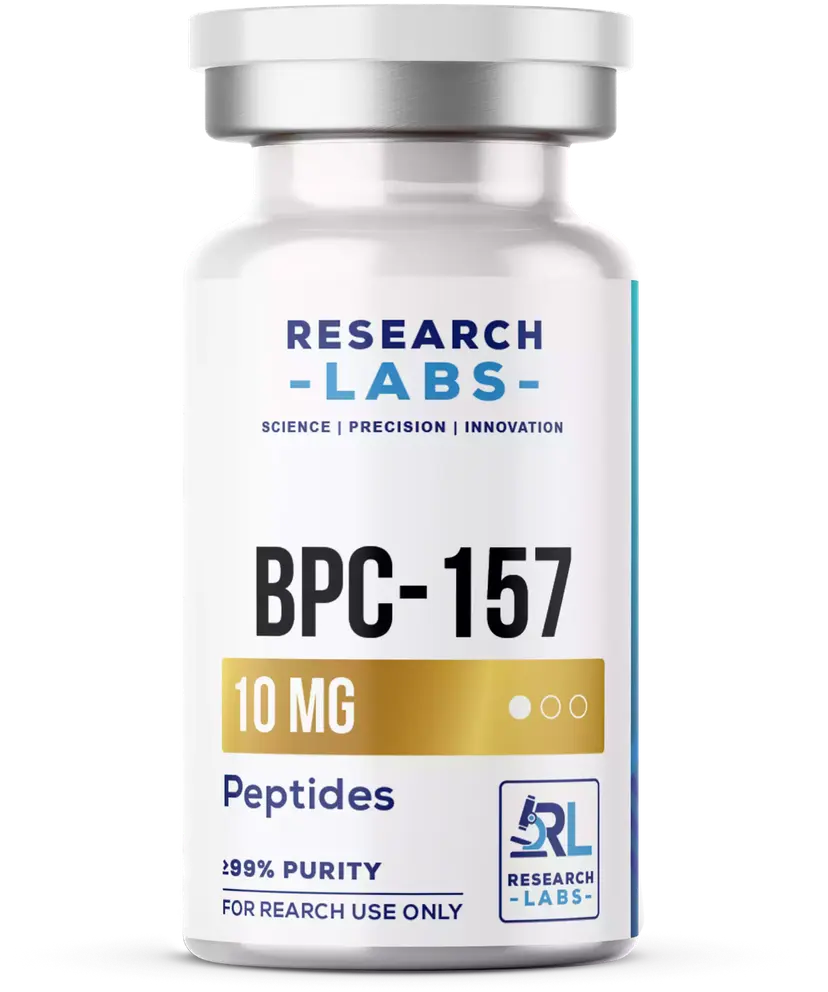
BPC-157 10mg batch-verified research vial format.
| Property | Detail |
|---|---|
| Classification | Linear synthetic pentadecapeptide. |
| Sequence | GEPPPGKPADDAGLV. |
| Molecular weight | About 1,419 Da. |
| Origin | A 15-amino-acid fragment associated with human gastric juice. |
| Common form | Free base or acetate salt. |
| Stability | Reported to be relatively stable in water and gastric juice in experimental settings. |
The sequence contains four proline residues, including a run of three consecutive prolines near the N-terminal end. This composition contributes to structural rigidity and is often discussed in relation to the peptide’s reported stability, although the exact relationship between sequence, conformation, and biological activity is not fully established.
Research Origins
BPC-157 was first described in 1993 by Sikiric and colleagues. The “157” refers to its position as the 157th candidate in an early screening program involving peptide fractions isolated from gastric juice.
Although it is associated with a gastric-juice-derived fragment, BPC-157 is generally produced synthetically for research. The specific 15-amino-acid sequence is considered central to its reported biological activity, and it does not show sequence homology with well-known intestinal peptides.
Proposed Mechanisms
Preclinical research suggests that BPC-157 may influence several biological pathways involved in repair and protection. The most consistently discussed mechanisms include angiogenesis, nitric-oxide signaling, fibroblast activity, collagen remodeling, and modulation of inflammatory signaling.
- Angiogenesis: BPC-157 has been associated with VEGFR2-mediated formation of new blood vessels, which may support tissue oxygenation and repair.
- Nitric oxide signaling: It may modulate nitric-oxide pathways, which are involved in vascular function, inflammation, and tissue protection.
- Cellular repair: Preclinical studies report effects on fibroblast activity and collagen remodeling, processes relevant to tendon, ligament, muscle, bone, and gastrointestinal tissue.
- Inflammation: Some animal studies report reduced pro-inflammatory cytokine activity and improved microvascular integrity.
- Growth hormone receptor signaling: Growth hormone receptor upregulation has been proposed as a possible mechanism, but this interaction has not been fully characterized.
A major limitation is that no high-affinity receptor or definitive molecular target for BPC-157 has been identified. That makes dose-response modeling and mechanistic interpretation more difficult than for drugs with established receptor targets.
What Animal Research Suggests
Most of the evidence for BPC-157 comes from rodent and other animal models. Reported effects include cytoprotection, improved healing in musculoskeletal tissues, gastrointestinal protection, and potential effects on vascular and inflammatory pathways.
Pharmacokinetic studies in rats and beagle dogs found that intramuscular bioavailability was approximately 14% to 19% in rats and 45% to 51% in dogs. The peptide also showed rapid clearance, with an elimination half-life below 30 minutes in the animal models studied.
These findings are scientifically interesting, but they do not establish that the same effects, doses, safety profile, or duration of action will occur in humans.
Human Evidence and Limitations
Human research on BPC-157 remains limited. Reviews note that there are no completed large clinical trials establishing efficacy, no validated human dosing regimen, and no approved pharmaceutical formulation.
The available human data are sparse and include small pilot studies, such as a two-person intravenous safety study. Those studies cannot establish effectiveness, optimal dosing, long-term safety, or risk in broader populations.
Regulatory Status
BPC-157 is not approved by the FDA or comparable major regulatory authorities as a human medicine. It is generally positioned as an investigational or research-use-only compound, and it should not be assumed to be safe or effective for self-treatment.
The FDA has also identified safety concerns for BPC-157 as a nominated bulk drug substance, and its compounding status remains under regulatory review.
Key Takeaway
BPC-157 is a well-defined synthetic pentadecapeptide with a plausible preclinical basis for tissue-repair research, but its clinical translation is incomplete. Its structure and animal-study history are clear; what remains uncertain is whether its reported effects translate reliably to humans, what mechanisms fully explain its activity, and what doses or exposure levels would be safe and effective in clinical settings.
Disclaimer: This article is for general information and research-market education only. It does not provide medical, legal, or regulatory advice. Peptide products available through RL Australia are for laboratory and research use only, are not for human consumption, and must not be used for personal, clinical, or therapeutic purposes. Purchasers must be 18 or older and agree to use products solely for legitimate research purposes.